Blockchain - Technologie: Bitcoin & Co.
Lesezeit: 4 min | Amelie Gärtner
4. Mai 2021

Was ist Blockchain?
Blockchain ist, wie der Name schon sagt, eine Kette aus Blöcken, welche Informationen speichern. Sobald Informationen in einen Block aufgenommen werden, ist es kaum möglich, diese wieder zu verändern.
Wenn ein Nutzer einen Block erstellt, wird eine Kopie des Blocks auf den Computern tausender Nutzer verbreitet.
Die sogenannten Miner agieren in einem Peer-to-Peer-Netzwerk (P2P), indem der stimmige Konsens geprüft und verifiziert wird, bevor er aktualisiert wird.
Stimmt alles überein, wird der neue Informationsblock der Datenbank hinzugefügt, sodass eine geordnete Block-Kette entsteht. Diese dezentrale Verbreitung klingt erstmals ungewöhnlich, gewährleistet aber die Sicherheit einer Blockchain.
Zur Absicherung werden kryptische Verfahren eingesetzt, sodass Datensätze selbst codiert werden können.
Wie ist eine Blockchain aufgebaut?
Ein einzelner Block besteht aus drei Teilen:Vergleichbar mit einem Fingerabdruck, da es einen Block samt Inhalt einzigartig identifiziert.
Der Hash wird berechnet, sobald ein Block kreiert wurde.
2. Hash des vorherigen Blocks:
Ein Block enthält immer den Hash des vorherigen Blocks, um sicher zustellen, dass die Daten unverändert sind und übereinstimmen, sodass eine sichere Kette entsteht. Bei Veränderungen eines Blocks, werden die folgenden Blöcke als ungültig erklärt, da der Hash nicht mehr übereinstimmt.
3. Daten:
Dies können beispielsweise Informationen über eine Transaktion, wie der Absender, Empfänger und Betrag sein.
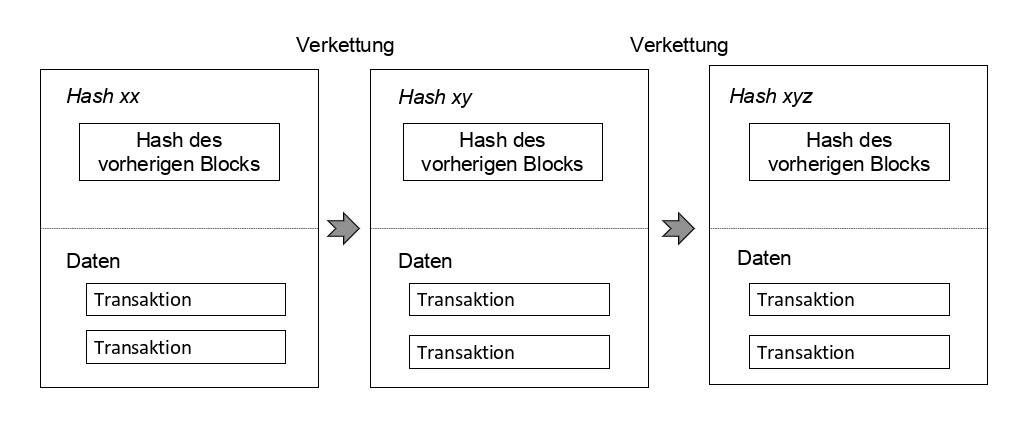
Durch die Verknüpfung der Hashes entsteht eine abgesicherte Verkettung der Blockchain.
Warum gilt eine Blockchain als besonders sicher?
Die Blockchain verfolgt gewisse Schutzziele, welche sich auf den Puncto Sicherheit fokussieren. Daten, die in der Blockchain abgelegt werden, sind durch die Verkettung der Hashfunktionen sichergestellt, sodass Daten nicht heimlich manipuliert werden können.
Gezielte Angriffe auf zentrale Stellen sind daher kaum möglich.
Grundsätzlich gilt, je länger die Blockchain, umso sicherer ist diese gegen Ausfälle und Angriffe geschützt.
Sollten durch Analysen Rückschlüsse auf reale Personen gezogen werden können, handelt es sich höchstens um Pseudonymität, da Nutzer nur mit Schlüsseln sichtbar sind.
Kommunikationspartner werden bezüglich ihrer Identität innerhalb des Netzwerks authentifiziert, um sicher zustellen, dass es sich auch wirklich um die angegebene Person handelt.
Welcher Zusammenhang besteht mit Bitcoin?
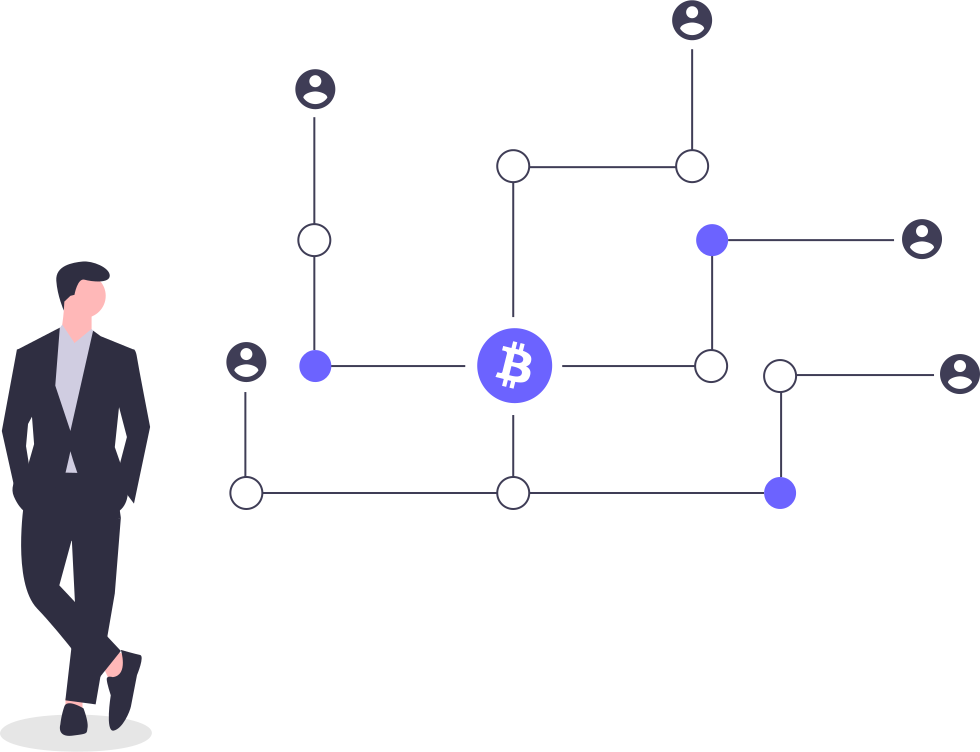
Das Konzept der Blockchain bildet die Basis von der Kryptowährung Bitcoin, einem dezentralen und kryptografisch abgesicherten Zahlungssystem. Die Datenbank besteht aus geordneten und unveränderbaren Einträgen und gleicht einem öffentlichen Register.
Diese Registereinträge stellen Transaktionen dar, bei den Bitcoin-Werte von einer Adresse auf eine andere überschrieben werden können, wie bei einer Kontonummer. Nutzer können sämtliche Transaktionen des Kontoinhabers sehen, aber das Konto keiner realen Person zuweisen.
Diese Transparenz hat zum Vorteil, dass Betrüger schnell erkannt und aus dem Netzwerk ausgeschlossen werden können.
Um Bitcoins zu verwalten, benötigt der Nutzer ein Bitcoin-Wallet. Diese können im Internet gekauft, umgetauscht oder als Belohnung an blockstellende Nutzer ausgeschüttet werden.
Mittlerweile wird die Kryptowährung Bitcoin von bereits vielen Unternehmen als anerkanntes Zahlungsmittel akzeptiert.
Welche Vor- und Nachteile bietet die Blockchain-Technologie?
| Vorteile | Nachteile |
|---|---|
| Hohe Sicherheit | Hoher Rechenaufwand |
| Geschwindigkeit der Transaktionen | Hoher Energieaufwand |
| Geordnete, transparente und konsistente Dokumentation jeder Transaktion | Hohe Transparenz an Dritte |
| Rückverfolgung von Vorgängen (Echtheitsprüfung, Betrugserkennung etc.) | Restrisiko einer Manipulation (51 % Attacke)* |
| Datenänderung kaum möglich | Daten in öffentlichen Blockchains werden nicht gelöscht, sodass es sich um Daten handeln könnte, die in der Vergangenheit missbraucht wurden. |
*51% Attacke: Hierbei handelt es sich um einen Netzwerkangriff, bei dem der Angreifer die absolute Mehrheit benötigt, Blockinformationen zu verändern. Diese Wahrscheinlichkeit ist allerdings sehr gering, da der Aufwand mit hohen Energiekosten verbunden ist und die Attacken nicht unbemerkt bleiben.
Fazit
Das Thema “Blockchain” ist natürlich viel komplexer und umfangreicher, aber die Stärke liegt in der dezentralen Struktur, welche einen sicheren Datenaustausch ermöglicht.
Außerdem wird hohe Sicherheit vor nachträglichen Änderungen mittels Konsens-Algorithmen geboten. Die neue Technologie steht zudem noch recht weit am Anfang, wird aber in der digitalen Wirtschaft häufig als eine der nächst großen Innovationen bezeichnet.
Für viele Unternehmen ist es ein spannendes Thema, da es neue Geschäftsmodelle bietet. Vor allem im Wirtschaftsbereich schreitet die technische Entwicklung voran, aber auch in der Logistik, im Einzelhandel und im Gesundheitssektor wird die Blockchain bereits verwendet.
So können beispielsweise Transporte von Produkten nachverfolgt und besser kontrolliert werden, aber auch sensible Daten sicher verwalten werden.
Berlin hat sich zu einem der weltweit führenden Zentren für Blockchain-Startups entwickelt.
leitzcloud jetzt 14 Tage kostenlos testen!
Quellen:
How does the blockchain work - simply explained (2017):
YouTube (Zugriff 23.04.2021)
Fill, Hans-Georg, Meier, Andreas (2020): Blockchain kompakt:
Springer Verlag (Zugriff 26.04.2021)
Liu, Shanhong (2019): Vorteile der Blockchain-Technologie weltweit:
Statista (Zugriff 29.04.2021)
Schönbohm, Arne (2019): Blockchain sicher gestalten:
Bundesamt für Sicherheit in der IT (Zugriff 03.05.2021)